Showing posts with label library. Show all posts

Friday, August 8, 2014

Pinkalicious ~ The Musical! - A Meek Moose Adventure at the Thea"tuh"

So my pal Andrea at Reading Toward the Stars does this Book Talk linky every Thursday.  Which is fabulous.  Because I love talking about books!  But I'm not so awesome ~ I haven't been fabulous at writing blog posts lately, and have never managed to link up with her.  Well! Today is the DAY!  Even though it's Friday.  And her linky is for Thursdays.  Baby steps, kittens!  At least I've got this in within 48 hours of her original posting.

Annnnnnd, her recent post is what kicked me in the butt.  I have had this post sitting in my drafts section since mid-June.  Andrea did a post about a new Pinkalicious book that is great for Back-To-School.  Back in June my sister was doing some freelance costume help working as a over-hire stitcher for Pinkalicious ~ The Musical!!!

When my sister, Traci, first told me about the musical, I was sort of "How can they make that book into a musical?" And this was foolish- because we all know anything can be made into a musical once you've seen the Simpson's episode about Troy McClure's comeback with the Broadway version of Planet of the Apes.


I don't know what this has to do with Mad Men.  But it was the only one I could find that actually had moving video from the episode.  So I'm gonna roll with it.

Anyway- my daughter has always loved pink, and Pinkalicious- so we decided to take her to go see it. She and I discussed the possibilities of how they could have changed this short picture book into an hour and a half musical the entire three hour car ride. (yes- THREE HOURS- three hours of NON-STOP TALKING- where is my Mother of the Year award?)  We were at a bit of a loss.  I just didn't know how they were going to manage it.

Prior to the show, which was at Adventure Theater in Glen Echo Park in Maryland, we went to dinner at an Irish Pub on the grounds before the show. Glen Echo park and Adventure theater are the cutest park and theater EVAH!  The park reminded me of parks you see in movies - carosel horse ride, dancing stage, bright bold colors! I'd like to go again.  Just not drive.  If a limo want to take me, I'm game.


Bangers and Mash, baby!


Just before the show, I was able to snap this picture of the set.  But then I found out that was a real no-no.  Otherwise, I would have filled my camera- everything was super "adorbs".


Which, honestly, is one reason why I don't read Pinkalicious to my kids at school.  I have it in my library, but it never makes it to the read-aloud basket. I try to pick books to read aloud that both my boys and girls can get engaged in.  And I always fear instantly turning the boys off if I sat down in our Living Room area together and said, "Let's curl up together and read this super adorable book, Pinkalicious!

The musical ended up shaming me enlightening my perspective.  It turns out that what the musical DID add in to the story line (and we knew they'd have to add something) was a call to arms against gender profiling. Amazing, yeah?  Ok, maybe I'm stretching the depth of the water here. But! stick with me for a sec.

There's this whole part to the plot line about the younger brother, Peter, and how he is being suppressed by his Dad's old-fashioned convictions on how pink is for girls and not boys.  And of course, little bro deep down LOVES the color pink. So much of the plot is about Peter's transformation into being honest about how he feels and embracing his love for the color. This also ties in to the end of the book where Peter eats so many cupcakes that he turns pink.

I realize from watching this musical that there is a way to get the boys involved in this story just by adding in some global awareness. Thereby opening up the doors for a discussion on being open-minded, taking risks, and challenging social conventions (when appropriate, of course).

Shaaaa- how are you going to manage that, Heather? Like, as if. Whatevs.

Trust me, kittens! Look- Global awareness- There are other countries that do not consider pink a feminine color. India for example.  There pink is a very manly color.  Other Eastern countries do not necessarily feel that pink is feminine.  In fact, it wasn't until after the 1940s that America and England started feeling that pink was feminine.  Up until that point, it was opposite.

Using the simple story of Pinkalicious as an opener for a discussion on whether or not the students think there are some things only boys or only girls should do would be eye opening- and also an opportunity to research those topics to see where the belief could be dispelled.  I remember being younger and hearing only women should cook- but look at all the male chefs on TV today? Art, design, business- all have held some gender bias, but there's so much out there that proves otherwise.  And the inquiry does not have to be bent on girl power- but balanced out so that boys can feel like they are free to explore different avenues as well.

I never really thought that this story could be something I could ever use to promote social change in seven year olds.  But there it is- just because I saw the musical.  I really hope that Victoria and Elizabeth Kann consider putting the musical on film so that it can be shared in classrooms.  In fact, I think I just need to ask them if they would.

I've gotten a little bold since joining Twitter if you haven't noticed.  It was having my tweet favorited by Dave Burgess (TWICE as a matter of fact) and a personal reply from Susan Branch that has clearly thrown me over the edge.  Now, if only Mike Rowe would acknowledge me- it would be all good.

Here were some photo ops with the cast:

Mr and Mrs Pinkalicious
Alison and Peter

Pinkalicious herself!

So, what do you think?  Did hearing about the theme of the musical get you to see Pinkalicious in a new light? What else do you think you could add to the discussion in your classrooms?  have another book you'd like to talk about?  Go link up with Andrea- EVERY THURSDAY (or Friday if you have time management issues like me)

post signature

Wednesday, June 4, 2014

Mr. Cookie Baker - an unexpected mentor text


***UPDATED with more pictures because I finally found my book! Sheesh 6/6/14***

I first owned Monica Wellington's Mr. Cookie Baker as a board book that I read to my youngest.  The book is bright, colorful, and I love cookies and baking.  So it was a win-win for reading to the baby. But the more I read it and noticed the illustrations, the more I got to feel that this would work excellently with my second graders as well. (The link to Monica's site also offers some activities to go with this book)

1. Illustrations

At my school we teach an Illustrations Unit to our kids.  It's one of my favorites to teach.  We spend time looking in books that we admire and noticing how Illustrations are an important part of the story.  They either clarify text, or add more information.  They can help the reader experience the emotion of your character or situation simply through facial expression or color choice.


What I like about Mr. Cookie Baker are how the illustrations frame the text- much like Jan Brett's technique in her books.  I like showing this to the kids as an example for if they don't feel comfortable with their drawing skills to draw one bog picture, they can assist the story by drawing small items around the edges.

2. Writer's Workshop
This book is also great for the beginning of the year to help reserved students realize they can still write a good story in a few sentences.  They just have to make sure their sentences are constructed with word choice in mind.

This book can come out again during our Informational Writing Unit as an example of How-To.  The entire story is a description of the steps the Baker takes everyday to make cookies and sell them to children.  Usually, How-Tos are straight directions.  This is a nice transitional example for kids still bent on the narrative form.


3. Math


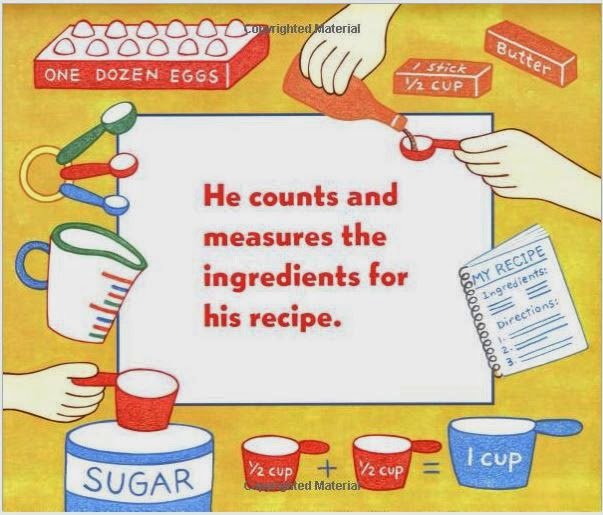
An example of math in real life.  The page above, in particular.  "He counts and measures..." shows the importance of precise work.  It leads to the discussion- What would his cookies be like if he had only estimated?  When would it be appropriate for him to estimate? A trip tot he grocery store for what he needs for the week, becomes a relevant answer.

The illustrations are a great intro to fractions.  The subject matter lends itself to hands on exploration of either making real cookies according to recipe, or craft dough for pretend cookies.  Either way- the kids are counting and measuring. And, so important- PROBLEM SOLVING.

Computation and Estimation lends itself to how many cookies did we cut out, how many have we baked, how many will we have all together? 

Skip Counting enters the court when we start looking at cookie sheets with set numbers of cookies on them.

Time is easily put into play with how long will they be in the oven?  What time will it be by the time they have cooled?  How long does it take to decorate one cookie, or twenty?

Money can't be forgotten ass the Baker sells the cookies near the end of the story.  how much should you charge for one cookie?  How much will you have if you sell ten?

I sincerely doubt that there is a math strand that can't be applied to this book.

4. Social Studies

No way! Yes way- Economics, my kittens.  Mr. Cookie Baker is a producer, the kids are consumers.  Mr. Cookie Baker uses several natural and capital resources during his day, and he himself is a human resource.  Does he provide a service, or does he sell goods?  Is it both?  What other producers does Mr. Cookie Baker have to rely on to make his cookies?  Is he therefore also a consumer?


And all this easily translates into enough background knowledge for the kiddos to design their own shop and list the natural and capital resources they would need to offer a service or sell a good.

5. Science

I've got to be kidding, right?  This is a book I read to a toddler for Pete's Sake!  But it's in there.  Solids, Liquids, and Gases when you analyze the ingredients Mr. Cookie Baker needs. Scientific Method if you just give the kids some ingredients to make craft dough but no instructions on how to actually do it. The role of evaporation as a cookie gets harder as each day goes by.


Convinced yet? If you click either picture, it'll take you to Amazon to buy it now! You know you want to!
I was inspired today to try to make some complimentary clipart.  My attempt is a freebie in my store for the next 48 hours.  I'd love to know what you think- as I did all of the art this time by myself. Click the picture below to go get a set.


Speaking of my wonderful sister- she's getting ready to go work on Pinkalicious: The Musical in the next few weeks.  She'll be making costumes!  How cool is that?  My daughter has always loved the Pinkalicious books!  I'm looking forward to getting to see the show and share about it here on the blog! Wow, I went a bit nutty with the exclamation points there, but it IS exciting!!! Ok. Now stop, Heather.  Stop.  But- if you're near the DC/Maryland area- you might want to check it out.


And even MORE news- 
I'm on a roll with the clip art, kittens.  I finished up the next Armadillo pack in the wee hours of the evening yesterday:


And of course, I had to make him a video:


I've been checking in regularly at the linky to see other teachers' book selections- and I've found tons more to load up my Amazon wishlist with (oh, but to win the lottery and spend it all at Amazon and Target!) - professional books too!  Go to Deanna's post to link up your own book - I want to know! and see all the other great ideas out there.  Thanks for the great linky, Deanna!


I'm going to go find some cookies...

GAR! I almost forgot!  Did you hear about Reading Rainbow on Kickstarter?  I do not have $10,000 for the chance to wear the one and only Geordi Laforge original STNG visor- but I did donate $25 for a great cause.  My first investment!  Next, up, the i-STAAPS!


post signature

Monday, July 16, 2012

Must Have Picture Books - My First Linky

And it freaks me out! Gads I hope I don't mess up!
*update* clearly I don't know my etiquette, and should have put in here that this here linky is hosted by Lindsey at The Teacher Wife.  And also I did find a typing mistake and feeeexed it. Someone beat me with a wet noodle.


The Teacher Wife


I love picture books.  I love the technique in illustration.  The precise language.  The labor of love that they must have been to write, and how excited the children get to read them and share them and love love love on them.  My classroom library has 40 baskets at this point, and I've bought more books this summer, so I know I'll have to add more come end of August.  But I care not! I love them so!  It's hard to pick the 5 BEST ones, but these are old favorites that I read again and again.

1. When Pigasso Met MootisseWhen Pigasso met Mootisse by Nina Laden serves many purposes.  For one, the illustrations are excellent, showcasing both styles of Picasso and Matisse, two of my favorite artists.  My second graders always think both styles are super cool, and want to try both out in their own drawings. Secondly, it's a great story for discussions on friendships, competition, respecting differences, and being unique.  It's a great text to refer back to often when dealing with friendship issues in the classroom. And as a great third reason, the end of the text has real information of both artists, to provide that non-fiction link that kids actually adore.  They LOVE finding out that these were actually real people.

2. RoxaboxenRoxaboxen by Alice McLerran is a beautiful story! I used to bawl like a baby at the end every time...but they make a pill for that now, so now I just choke up a little. Anyway, I tend to like books that do a lot of different jobs for me in the classroom.  This book is a great example of memoir, and I can use it in Writer's Workshop as an example for writing about small moments.  I also use this book as an introduction to my economics unit, as the children in the story create their own town, and it's a fantastic springboard for getting my kids to think about what they would need in their town that they are going to create.  It also works for showing changes over time, which is a social studies standard. 


3. Tough BorisTough Boris by Mem Fox is AWESOME.  I'm starting to worry that I'm running out of adjectives for this post.  All of these books are incredible.  What makes Tough Boris special?  I use it for my illustration unit to show how the picture can show a story that the words don't tell. Which also makes it great for that Daily 5 lesson on Three Ways to Read a Book.  This book has a repetitive text structure, which makes it great for the kids to quickly catch on and echo back the lines with you.  And it teaches about stereotypes.  You can spend the whole book thinking about how awful pirates are and then find out that they are capable of loving and being loved just like everybody else.  But not in a hit over your head sort of way.  This was also a tear jerker for me.  The kids would be all, "Why are you crying AGAIN?" Ah, pills are good.

4. Ms. Rubinstein's Beauty  Ms. Rubinstein's Beauty by Pep Montserrat.  I hesitated on this one when I found out that it's no longer being sold, which I guess means it's not being printed anymore? But I MUST post it, because it is, insert adjective that means so super fabulous beyond belief here. Look for it at yard sales, or borrow it from the library.  This, like Tough Boris, works for teaching about stereotypes and how everyone is beautiful and has worth and how we all need to look for the good in people and be open minded.  BECAUSE Ms. Rubinstein is the bearded lady at a traveling circus.  I will not give away the rest.  But it is a beautiful love story. *sigh*

5. Miss Rumphius Miss Rumphius by Barbara Cooney. Who, coincidentally, illustrated Roxaboxen.  A sweet story about a woman who decided to make the world beautiful.  I have always used this book as a beginning of the year read aloud and had the kids write a little paragraph about how they would make the world beautiful.  Providing kids with opportunities to think about how to give back to the world is so necessary as we nudge their character building.  It's a great example of memoir, small moments, beautiful language, and changes over time.  I also want to point you in the direction of Wendy at Teacher's Toolkit, who also uses this book in her classroom.  But she went an amazing step farther and has a free powerpoint of lupin pictures that she shares with the kids and then they make these gorgeous fingerprint paintings.  It is an inspiring project, and I want to combine it with my writing activity and have the kids create lupin paintings for a bulletin board display and then put up our paragraphs of how we'd make the world beautiful.  A great opportunity for text to self and text to world connections.  Please go give Wendy a visit and give her props for her beautiful art project!

Oh this is sad!  Only FIVE books!  And now I wish I had been able to add in Interrupting Chicken by David Ezra Stein because of how it shows the writer's process, or I Love Guinea Pigs by Dick King-Smith with how it pairs non-fiction informational text features with memoir, or Chin Yu Men and the Ginger Cat by Jennifer Armstrong because it works in wonderfully with my Ancient China unit and character education, or When I was Young in the Mountains by Cynthia Rylant for small moments! There are so many.  Sniff.


Saturday, May 12, 2012

Reading up


This is my tenth year teaching, but not consecutively.  I had a couple of years off recently, and now that I'm back in the saddle, I'm at a new school with a new way of doing things, and I feel - well, NEW.  I don't know if I would have gotten exposed to this book or not at my old job.  And to be fair, I will leave the possibility open that I might have.  But I don't know if I would have gone through the anticipation of implementing it. I had gotten pretty complacent with my teaching style.  But. as I mentioned earlier this week- I sway easily to group dynamics.  Since my co-workers are pretty big into the Daily 5, I figured I should give it a shot.

I finished my reading today, in between dealing with my oldest having an Autism super meltdown, my middle having a birthday party, and my youngest deciding that 13 months is the perfect time to abandon napping- so actually, I'm surprised I found the time.  But it is an excellent read.  I suppose on one level I feel pretty dopey for never having heard of it before.  But then again, I'm also relieved that I've been exposed to it now.  Earlier in the week as I had been reading it, I tried out a couple of the management style tips as far as practicing correct models for muscle memory and creating I charts- and I was impressed with the results.  Definitely something to kick off next year with, and perfect for practicing now.

I already downloaded the CAFE book and hope to have devoured that in the next week.


This is another book I am a big fan of.  The Title I coordinator in our building put me on to it while she was doing a fabulous job giving me some training and pointers for the Jan Richardson Guided Reading Approach.  (*sigh* Another thing I knew nothing about, even with nine years of teaching behind me. Like I said, I'm a total newbie again, back on square one)  What I love about this book are the visual manipulative approach for teaching young readers some sophisticated comprehension strategies.

My kids can actually USE the word "schema" correctly because of this book.  And so can I, for that matter.  It's an easy read, the materials for the visual presentations are easy to come by or to make- and the lessons are fun (to teach and learn).  There is a "whose garbage is this" sort of activity for teaching kids the skill of inferring, and it was so much fun to show the kids some random objects from around my house and see how they created a whole explanation as to how I must have had a birthday party.  I hadn't actually had a party, but they gave sound explanations and evidence as to how I could have.  And they have great anchor charts for the kids to reference for all of the strategies.  I've taught these strategies before, but always with worksheets, and never had the results like I am seeing from using this book.

If somehow, I am not the only person on the planet that hadn't read these books yet, and you're out there saying "Whaaa?" Then by all means check them out.  You will not be disappointed.

And then to just finish this week out, and before I re-evaluate my Great To-Do List challenge for next week, I would like to acknowledge that I got my library all fixed up and spiffy at school.  Baskets are labeled, books are sorted, and I think it's looking swell!


All of my regular books are now fitting on three bookcases, and one display rack. No, my baskets don't all match, but I've got to make do with what I have.  Maybe I can spray paint them for next year, but I'm not worried about it at the moment. I started this job at the end of September- the school had too many kids in the classroom for being a Title I school, so they had to add a new position- and I'm so glad they had to.  I love this new job!- But I inherited everything, luckily for me, extremely nice things too.  One of the freebies was a set of book basket labels from Really Good Stuff.  I've seen them before, but had never bothered with the purchase- but now I've found out I really like them and will be buying another set, as I ended up with 39 total baskets.  There's the link if you'd like to look at them for yourself:

I ended up with 39 categories after I was looking at some overflowing baskets and realized I was just going to end up breaking the basket and also that I was over-generalizing some categories.  Especially the picture books.  Yeah, just about everything is a picture book.  So I really tried to separate them out based on what I might need them for, as well as what the kids might be looking for.  For example, we teach an illustration unit at the beginning of the school year for writer's workshop, so I set aside some specific picture books that I felt would be good examples for that unit and put them in a basket labeled "Books With Great Illustrations".  Also I have a basket for "Books With Beautiful Language" for when I need examples for really choosing your words carefully for mood in writer's workshop.  I also made a special category for Wordless Books, and Books that are in Letter Form, and a basket of award winning authors, as well as My favorite read-alouds.  When a book really didn't seem to fit in a specific category, I noticed that they generally fell into either a family story or a friendship story.  So I've got those baskets too.


Some books are just too big to be in a basket and fit on a shelf, so they are in the display rack.  I have two of these racks, but I generally like to put books that match our window of inquiry content on the other one.  This rack is pretty full though, so I may have to rethink that, or get another rack...  And then I also have a modest collection of big books, and I put my listening center baskets on top of their cupboard.  I have individual CD players that the kids use.  I find that it avoids the inevitable argument that arises from too many kids around one CD player.  This way they can just scamper off to a private corner and not worry about who wants the volume changed or who wants to hog the book to themselves.

The books are easy to put away- as the kids don't actually have to remember what the title of the basket was.  They just match the number on the sticker on the book.  So each basket, aside from having a title, is also assigned a number.  And then I just stick little round label stickers on the front, top right corner or each book and write the corresponding number in the circle.  Kids find it extremely easy to know where a book goes.  Books that are "too big to be allowed" have a sticker, but no number.  

I did not take a picture of where I have my non-fiction brochure resources filed yet, as they are sharing shelving unit space with math manipulatives and I have that in a bit of an un-holy mess right now.  But, cleaning up that section is on this coming week's to-do list, so it's only a matter of time.

Another thing I like about my library categories is now I can see what type of book I may be lacking, and where I really don't need any more on that topic.  And that knowledge is going to help me immensely as I sojourn to the great GreenValley Book Fair in the morn.  May the force be with me!

Saturday, May 5, 2012

My New Love Affair with Non-Fiction

I was taking writer's workshop training this year when my instructors played a clip of a Tony Stead lecture.  If you haven't seen, heard, or read Tony Stead yet- by all means RUN, do not walk, to your closest source of information dispersal and load him up!

My school is very committed to the Lucy Calkins writer's workshop method; it's a school-wide endeavor.  Every teacher is equipped with the books, and it's so embedded in the curriculum that when anyone talks about workshop, Lucy is referred to by her first name.  So why we were played this clip I'm not so sure- because there is a moment where he really sort of hangs personal narrative out to dry- but regardless of that- he had me hooked.

There was this fact about how like, 85% of real-world reading is different forms of non-fiction.  But go look in your classroom library, and you'll probably find that 85% or more of it is fiction.  And then look at the non-fiction you do have, and notice how it's pretty much animals, biography possibly, and how to draw dinosaurs.  His discussion of the process of of teaching children researching and writing non-fiction pieces was mesmerizing.  I got his first book immediately, and then even went and bought the second.

It was an easy read, written in a very conversational tone, and delivered in examples of how it was taught in actual classrooms with all ages of children.  One of the methods I like the best is how you do a pre-assessment with the children by having them write what they *think* that particular form of nonfiction should look like.  Then you lead the workshop and in the culminating activity, they do that project again with all of their new found knowledge and you can compare the two pieces to see how much they actually took in.

So, yes, unequivocally- I love this book.  If I find his address I will be sure to write him my first ever fan letter.  As long as writing to Tootsie Roll Pops about whether or not they really give you a free pop if your wrapper has an Indian Chief shooting a star on it wasn't considered a fan letter...

As far as my personal library goes- I've started branching out to get more nonfiction resources.  At this moment, aside from my animals and biographies, and how-to books, I've added in magazines and newspapers, catalogs, brochures, take-out menus, and maps.  Something I never really thought the kids would want to look at.  But everyday- there goes one of them to pull out that big road map and completely unfold it and five of them gather around it in a little circle and run their fingers over the lines and talk about all of the words next to the "dots".  I went ahead and bought one of those fancy pop out maps of DC and they nearly went into hysterics to be the first to look at it.

And I must mention- with a great amount of appreciation- how my friends have been helping with this endeavor.  I messaged a great many of my Face Book friends around the country and the world asking them to mail in non-fiction samples as they came across them- and they have sent me the most amazing things.  And that is a simple request you can ask anybody you know- Hey, they next time you go out to eat, can you grab me a take out menu?  If you go for a drive this weekend, can you stop at a rest stop and grab me some tourist brochures?  On your trip to china can you pick me up every dang piece of paper you come across?

My kids still look at the fiction.  But I find it newly thrilling to see them get excited over investigating a plant catalog.  I will be expanding on this idea for ages I think, and find new ways to make this non-fiction obsession useful to both them, and me.